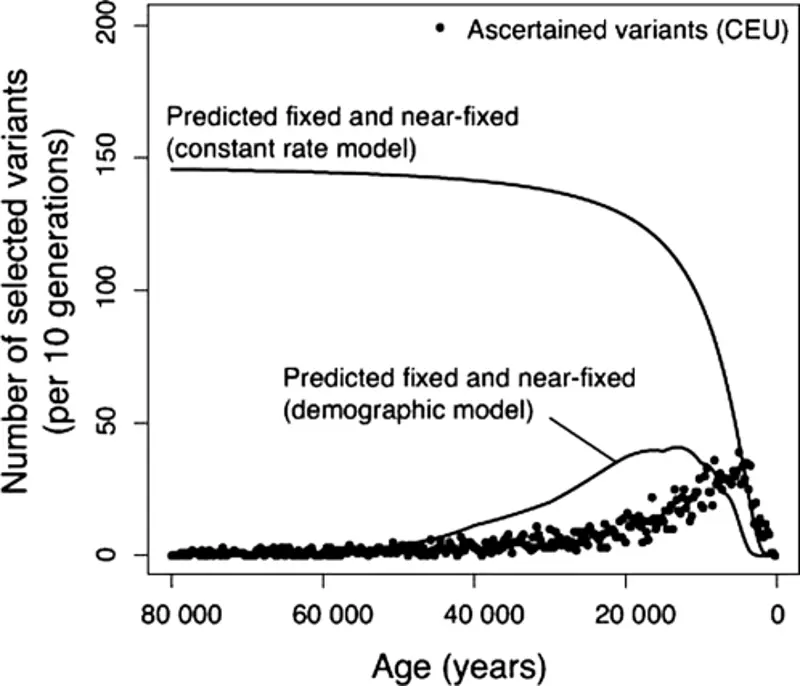
HapMap data identifies 2,803 selection events in Europeans (CEU), 3,486 in Africans (YRI), 2,367 in Han Chinese (CHB), 2,783 in Japanese (JPT). YRI shows peak selected variant age of 8,000 years ago, CEU peaks at 5,250 years ago. Africans have more detected events due to larger ancestral population and slower LD decay. Constant selection rate refuted because it predicts 10-fold lower heterozygosity than observed. Constant rate predicts strong heterozygosity-recombination link absent in humans. Constant rate implies 6.4 million human-chimp adaptive substitutions, far exceeding observed 40,000 amino acid changes. Constant rate expects nearly 100 times more high-frequency LD blocks than found. Demographic growth model fits age distributions with lower selection intensity. Sub-Saharan African population grew later than Eurasian due to delayed agriculture. Neolithic expansions drove pulses of recent selection in Europe and Asia. Most selected variants are population-specific, few shared between Africans and Europeans. Recent selection affects 7% of human genes. Selection creates long-range LD blocks distinguishing it from bottlenecks. Higher SNP density confirms most events under 80,000 years old. Cultural and ecological shifts fueled genetic adaptation to diet and disease. Agriculture intensified selection on disease resistance genes. Human evolution rate now over 100 times higher than most of history.
Comments
Be the first to comment!