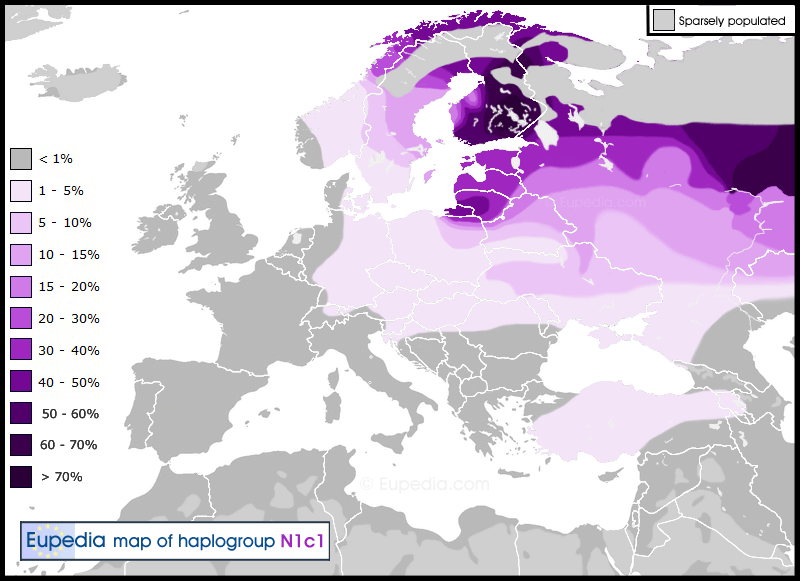
N1c peaks at 61% in Finns, 53% in Lapland, 42% in Lithuanians. N1c dominates Uralic tribes like Nenets (95%), Nganassans (100%), Yakuts (90%). Originated in Indochina or southern China 15,000-20,000 years ago from East Asian NO. Neolithic Manchuria had 37% N1, including N1c roots in Hongshan culture. N1c1-Tat found in 41% of 3600-2900 BCE Chinese Xueshan culture samples. Spread across Siberia to Volga-Ural by 5500-4500 BCE with Kama culture. Reached eastern Baltic via Comb Ceramic culture 4200-2000 BCE, ancestors of Finnic-Balts. Bronze Age merger of N1c Proto-Uralics and R1a Indo-Europeans formed Kiukainen culture. Modern Balts have equal N1c1 and R1a from this hybrid. N1c absent in Bronze Age Estonia, arrived Iron Age around 500 BCE. N1c phylogeny splits match Uralic branches: Ugric 4200ya, Balto-Finnic 3600ya. N1c links Uralic to Altaic languages via shared East Asian origins. 7th century Avars carried N1c1-F4205 with Siberian mtDNA. Rurik dynasty founders carried Scandinavian N1c1-L550. Lithuanian Gediminid and Polish Jagiellonian dynasties belong to N1c1.
Comments
Be the first to comment!