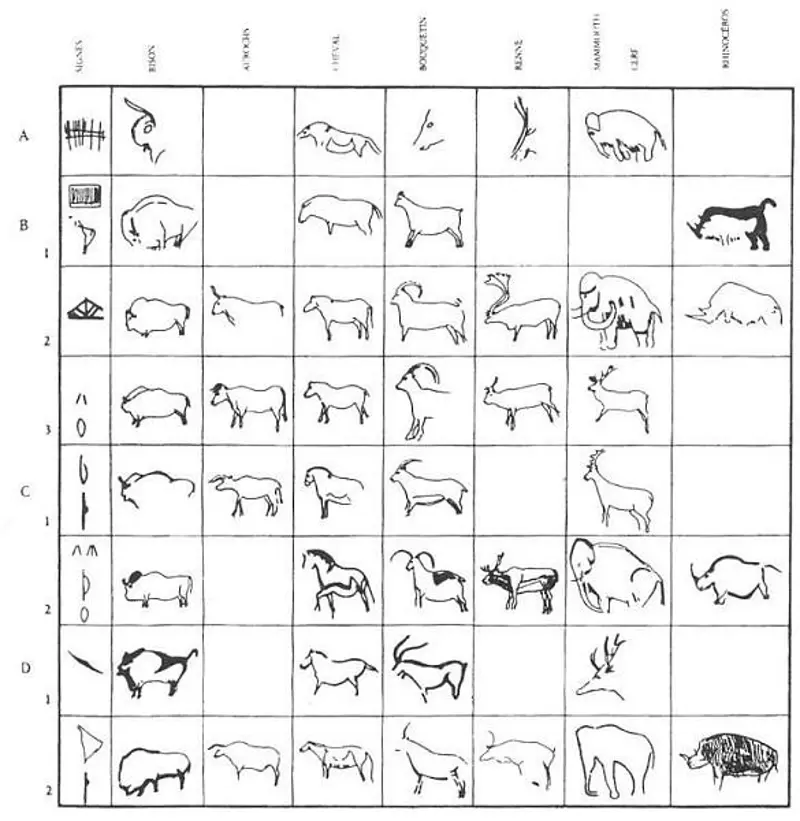
Aurignacian culture in Europe produced the earliest lunar calendars around 32,000 B.C. Marshack deciphered bone marks as lunar phase records with controlled line thickness. Portable calendars on bone aided long hunting migrations. Marks imply arithmetic counting of lunar cycles and seasons. Lunar notations link to ecliptic, solstices, and earthly changes. Upper Paleolithic astronomer-priests understood mathematical sets. Brightest youths trained as astronomer-priests. H. erectus populations in Europe ancestral to Magdalenians. Australopithecines in Africa possibly first linked seasons to celestial cycles. Cave art prioritizes ritual animals over dietary ones. Orion constellation carved on German mammoth tusk dated 38,000-32,000 B.C. Ivory tablet notches count 86 days for human gestation or Betelgeuse visibility. Orion figure matches starry pose with belt, sword, and short left leg. Rappenglück identifies Magdalenian zodiac and cosmology. El Castillo cave in Spain shows 14,000 B.P. Northern Crown star map. Aurochs link to Taurus constellation and solstice events. Pleiades tied to aurochs rutting season. Lunar calendars central to Ice Age observational astronomy.
Comments
Be the first to comment!