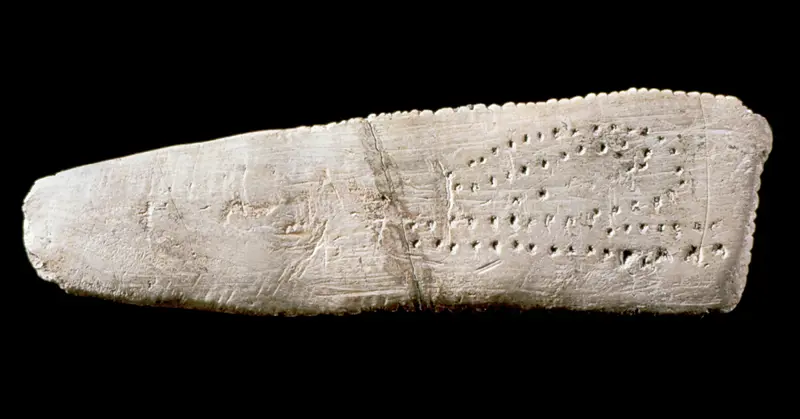
Marshack microscopically examined 30,000-year-old Lartet and Blanchard bones from France. Markings show 24 tool changes for 69 sequential strokes proving intentional notation. Notches follow lunar phrasing patterns despite irregularities from weather or errors. Ishango bone from 11,000-year-old African site has grouped notches like primes or doublings indicating proto-math. Serial engraving over time rules out single-session doodling or art. Paleolithic creators performed time-factoring cognition akin to NASA scientists. Marshack's rigid schema extracts lunar cycles from chaotic pits. Archaeologists previously dismissed bones as meaningless decoration. De Heinzelin first suspected Ishango notches as arithmetical game. Marshack paralleled his notation method to ancient makers' rationalism. Mismatches resolved by multi-cycle averaging and observational flaws. Sequential marks demonstrate purposeful non-decorative intent.
Comments
Be the first to comment!