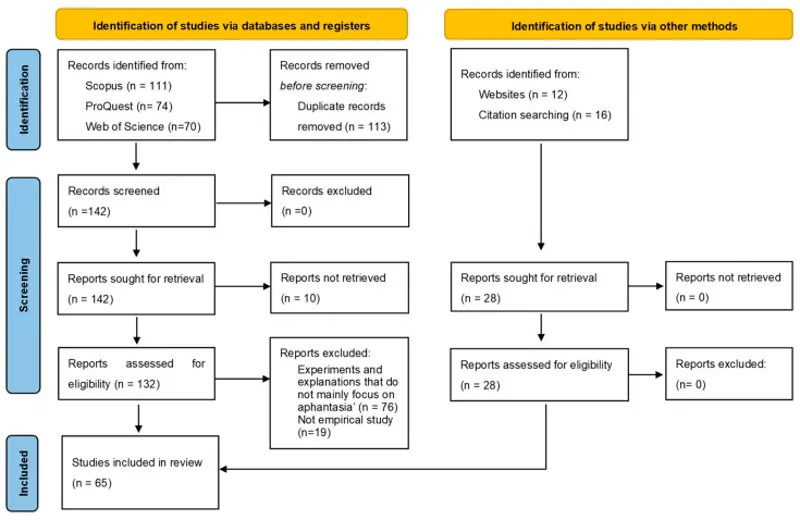
Aphantasia prevalence ranges 0.7-5.9% by VVIQ criteria. No gender differences in aphantasia rates. Family history suggests genetic basis despite one null study. Many aphantasics lack imagery in all sensory modalities. Aphantasics show poorer episodic and autobiographical memory. Aphantasics perform worse in demanding visual working memory tasks. Object imagery impaired in aphantasics while spatial imagery mixed. Aphantasics have poorer atemporal and future imagination. Mental rotation accuracy normal or superior but slower in aphantasics. Visual search slower in aphantasics due to lacking imagery priming. Aphantasics experience reduced emotional responses and empathy. Aphantasia associates with higher autism quotient scores. Aphantasics show reduced face recognition ability and prosopagnosia comorbidity. Neural deficits center on fusiform gyrus and prefrontal-visual connectivity. Aphantasia subtypes include visual-only and multisensory. Acquired aphantasia follows brain injury, stroke, or COVID-19. Review demands refined definition, objective measures, and neural studies.
Comments
Be the first to comment!