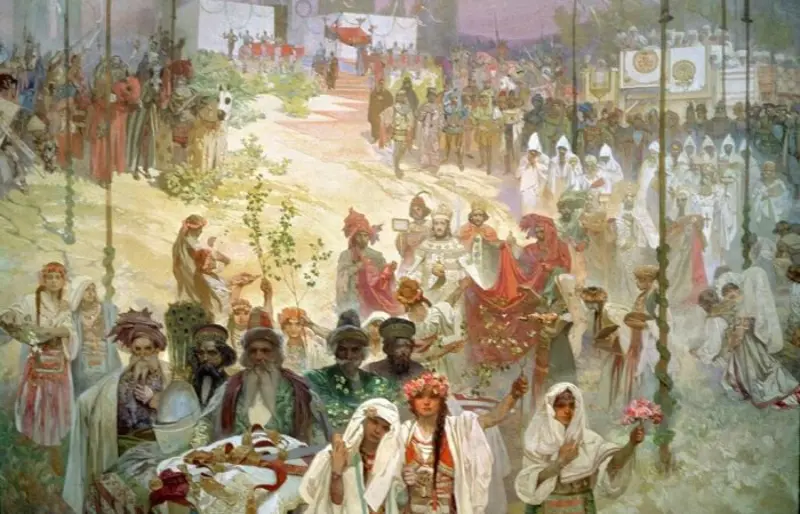
Slavs originated between Dniester and Don rivers in southern Belarus-central Ukraine. Large-scale migrations from 6th century spread Eastern European ancestry across Central-Eastern Europe. Eastern Germany saw over 85% ancestry replacement by Slavic migrants after Thuringian decline. Poland's pre-Slavic Northern-Scandinavian population largely vanished, replaced by Eastern newcomers related to modern Poles-Ukrainians-Belarusians. Croatia-Balkans showed Eastern ancestry influx mixing with locals, forming hybrids with 50% or less Slavic input. No sex bias in migrations as entire families moved together. Slavic societies organized around large patrilineal extended families unlike prior nuclear ones. Modern Sorbs retain early medieval Slavic genetics despite cultural shifts. Slavic expansion was demic diffusion by flexible kinship groups without hierarchies. Genetic signal from Ukraine persisted in Czechia's Moravian principality through 10th century. Early Slavic graves in Poland's Gródek confirm Eastern migrant origins. Brücken cemetery shifted from diverse Migration Period ancestry to uniform Slavic profile. Slavs adapted variably: replacement in north, admixture in south. Population turnover aligned with Slavic material culture like Prague-Korchak. Slavic migrations were Europe's last continent-scale genetic reshape.
Comments
Be the first to comment!