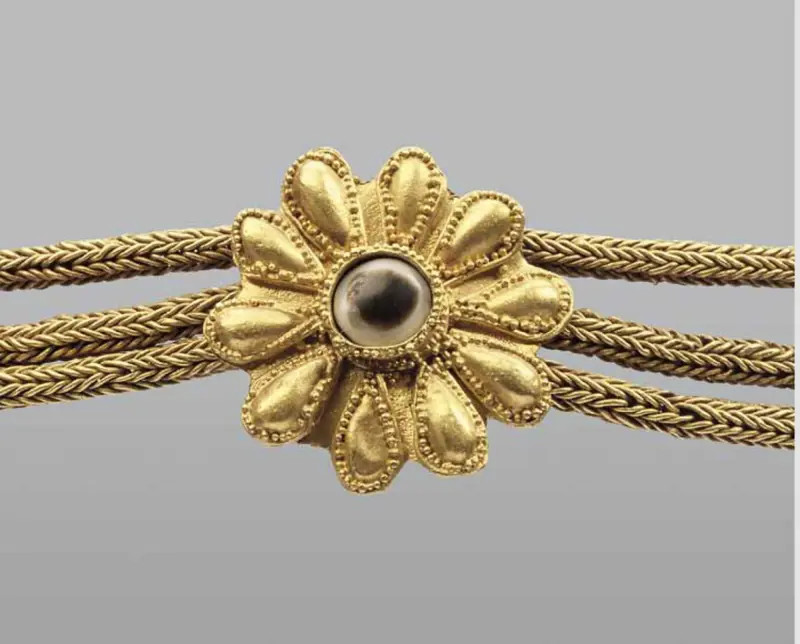
Kelermes kurgans built second half of 7th century BCE over Bronze Age site. Chain of 34 nobility kurgans plus commoner necropolis. Many plundered but yielded Near Eastern campaign artifacts. Gold diadem from Litoi Kurgan dated 8th-7th century BCE Urartian or Syrian origin reworked by Scythians. Diadem has three gold wire plaited ropes through nine rosettes with sardonyx granulation chains crescent pendants hollow balls. Miller described diadem as finely wrought interwoven links like modern work. Original had 16 small metal balls per Pridik reconstruction. Quiver clasp from Kelermes Barrow No. 3 mid-7th century BCE. Gold pole-top ending in rosette from Kelermes mound 3 matches Sargon relief bracelet. Rosette armlet matches Ashurnasirpal II relief. Central grave had limestone sacrificial slab for libations. Southwest grave held noble woman skeleton with gold griffin-head diadem twisted gold neck torc. Woman had gold chains and rosette pole-top at left hand. Finds in Hermitage from Melgunov Schultz excavations. Scythians formed early cultural complex blending local and Trans-Kuban imports.
Comments
Be the first to comment!