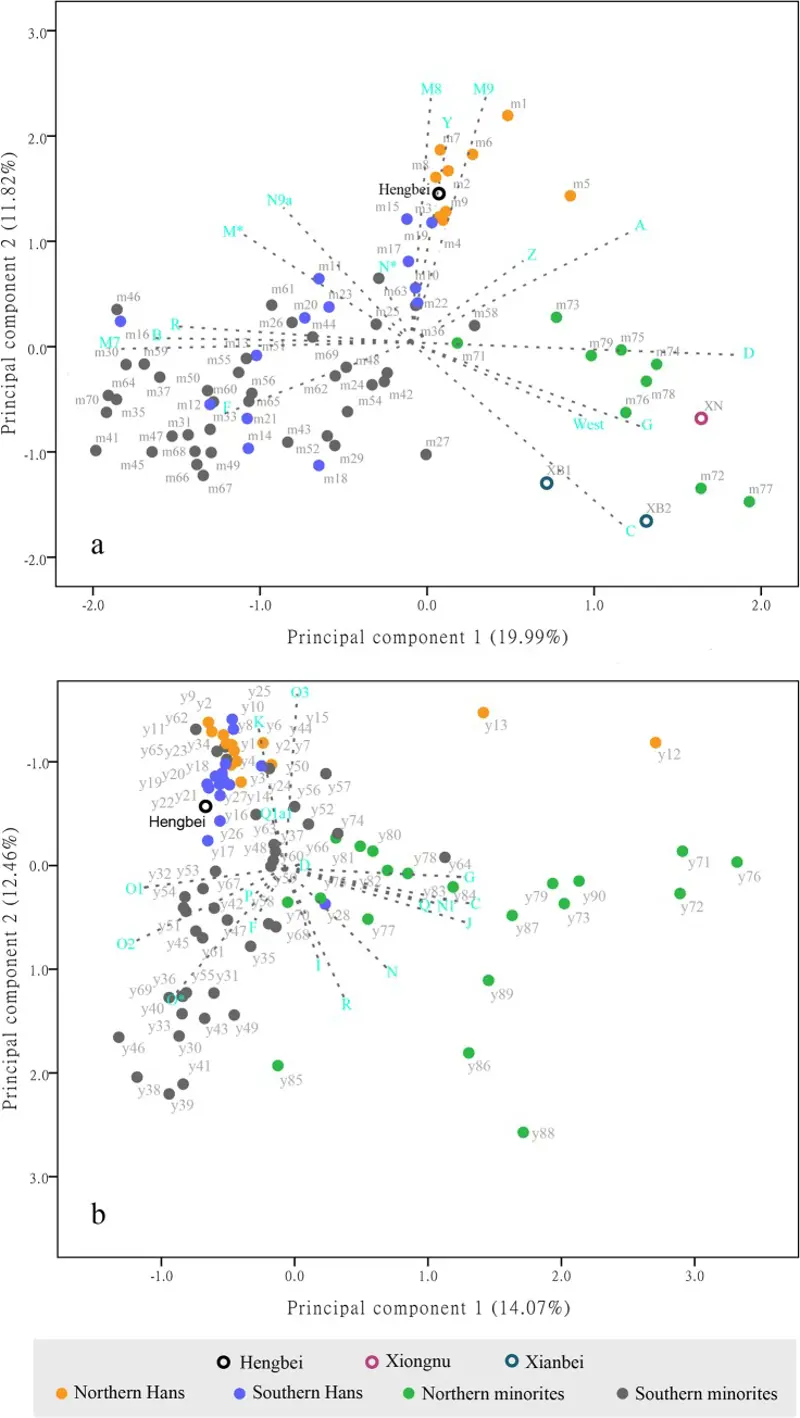
Hengbei ancients from 3000 years ago genetically match modern northern Han Chinese maternally and paternally. Haplogroups D, B, F, A dominate Hengbei like northern Han at 23%, 12.5%, 11%, 11%. Northern East Asian haplogroups 50% in Hengbei mirror northern Han dominance. PCA clusters Hengbei tightly with northern Han, away from southern Han and minorities. Hengbei shares most mtDNA haplotypes with northern Han, significantly more than others. F_ST between Hengbei and northern Han lowest at -0.00183, non-significant. F_ST higher for Hengbei vs southern Han, northern minorities, southern minorities. Genetic distance maps show Hengbei closest to northern Han populations. Y-haplogroups O3 and Q1a1 in Hengbei match Han Chinese paternal lines. Hengbei distinct from ancient Xiongnu and Xianbei maternally and paternally. Northern minorities cluster separately from northern Han despite shared geography. Ancient northern nomads contributed little to northern Han genetics. Han ancestors' farming lifestyle enabled genetic replacement of northern nomads. Southern Han formed from northern Han migrants mixing equally with southern natives. Northern Han show no significant genetic differences across regions. Hengbei high haplotype diversity 0.993 matches modern populations. All Hengbei mtDNA haplogroups East Eurasian, no Western admixture noted. Northern Han genetics stable for 3000 years due to demographic dominance.
Comments
Be the first to comment!