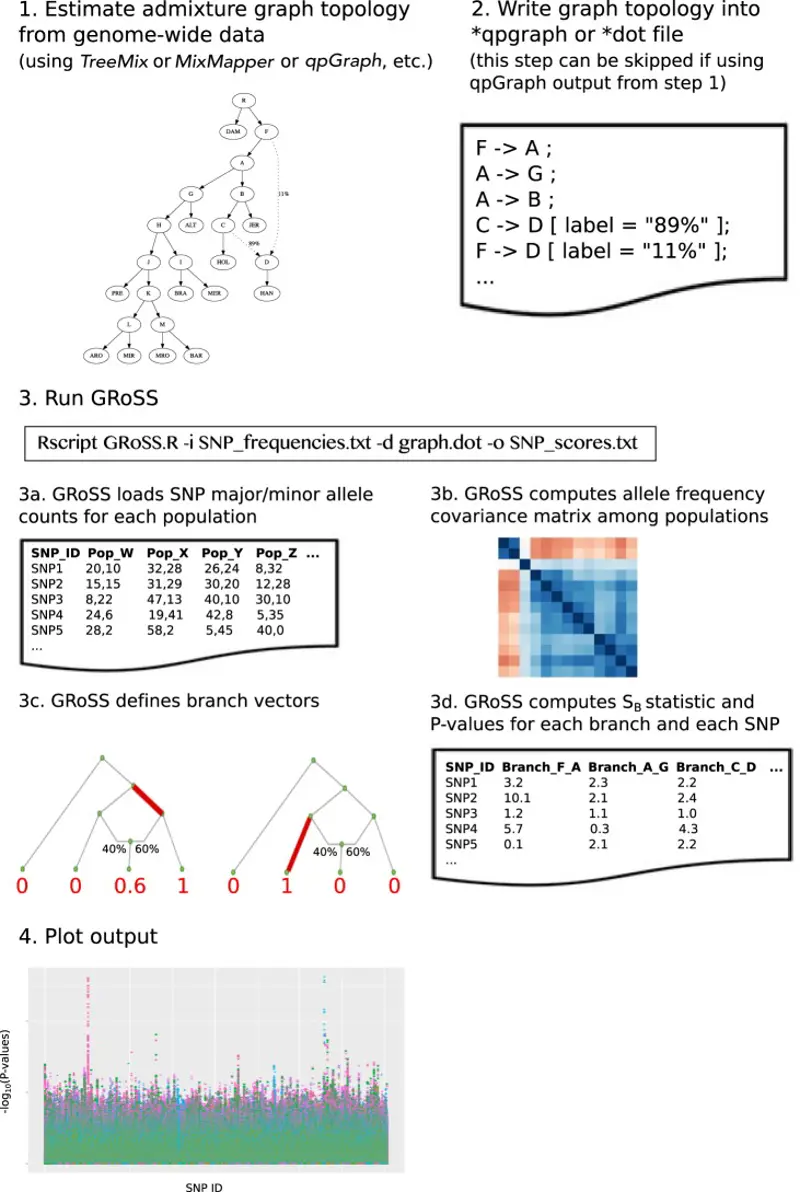
GRoSS accurately localizes selective sweeps to correct branches in simulations even with admixture and bottlenecks. Method outperforms pairwise FST and PBS by using full graph topology. Recovers known human selection signals like lactase persistence in northern Europeans and skin pigmentation in Europeans and East Asians. IGH immune cluster under strongest selection on Chinese Dai branch. TARBP1 at >50% frequency in East Asians but <2% elsewhere signals pathogen resistance adaptation. NFAM1 immune gene selected in East Asians. Native Americans show selection on GSK3B neuronal kinase, GPR156 receptor, protamine spermatogenesis cluster, and MDGA2 nervous system gene. Protocadherin cluster selected in docile Romanian Grey cattle for tameness and neuronal function. 4.4 Mb region in Holstein cattle selected for milk yield, muscle, and neurodegeneration genes. Maremmana cattle branch shows selection for massive body structure and muscle genes. Codfish inversions on LG01, LG02, LG07, LG12 drive ecotype differentiation strongest in north/east Atlantic branches. East Asians uniquely adapted TARBP1 HIV-binding protein absent elsewhere. Method robust to low sample sizes down to 4 diploids per population.
Comments
Be the first to comment!