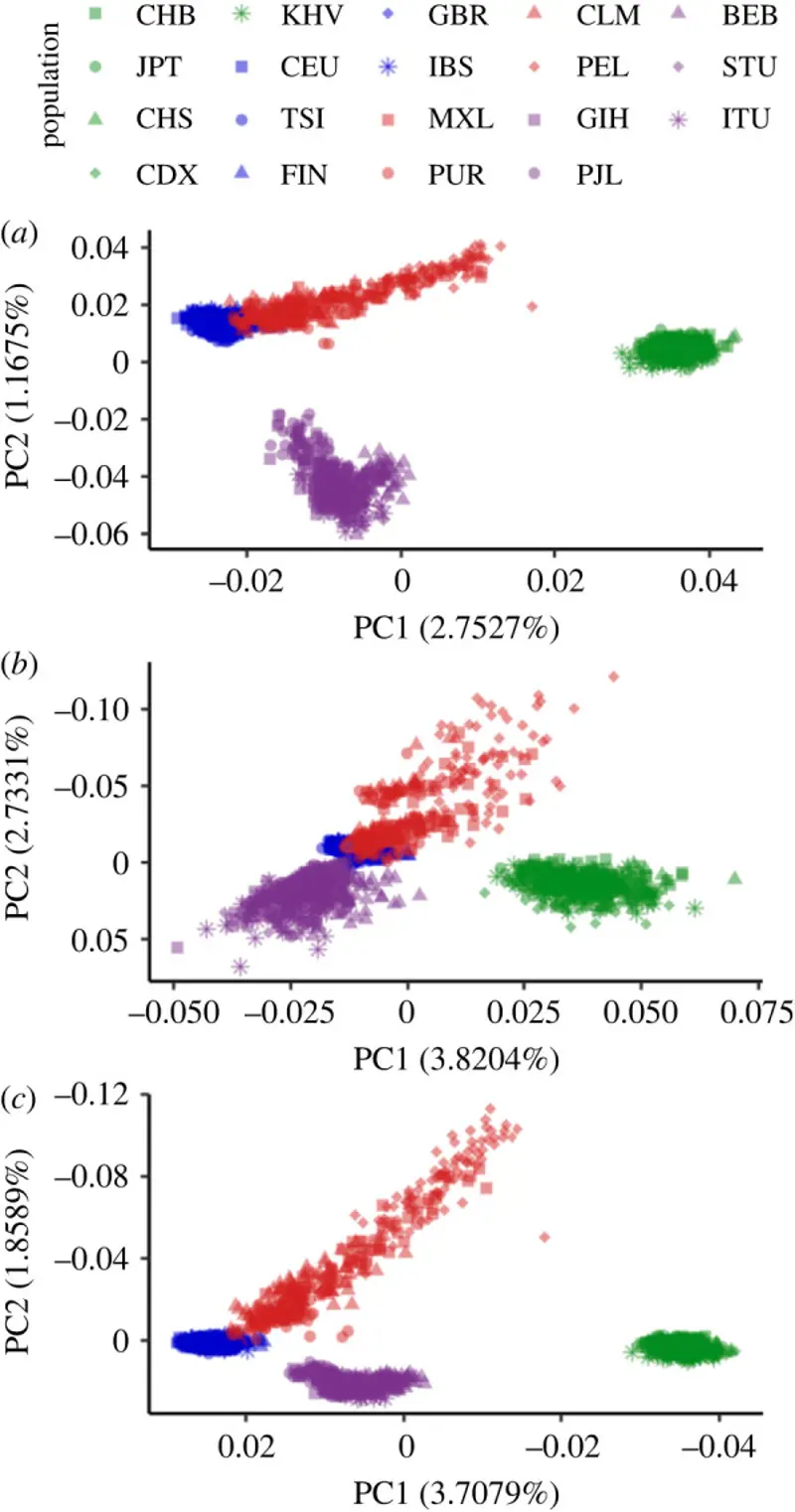
South Asians have nearly twice the population-unique archaic alleles versus Europeans or East Asians. East Asian individuals harbor more Neanderthal ancestry than European individuals. European populations recover more Neanderthal SNPs across samples than equal-sized East Asian samples. Patterns match simulations with multiple Neanderthal admixture events into Eurasians. Archaic alleles alone distinguish Europeans, East Asians, and South Asians in PCA like modern SNPs. Denisovan-unique alleles are mostly private to South Asians (45%) and East Asians (27%). 35% of archaic variants in Eurasians are unique to one population, mostly South Asian. South Asians recover more of the Neanderthal genome from equal sample sizes than Europeans or East Asians. Europeans received gene flow diluting Neanderthal ancestry post-admixture. East Asians' higher individual Neanderthal stems from second admixture pulse after Eurasian split. Archaic ancestry coverage rises with sample size but shows population-specific patterns. SNP counting method reliably detects introgressed archaic alleles with high power. False positives from ancestral alleles are minimal at 4%. Neanderthal sites mostly shared across Eurasians but Denisovan more regional. Admixed Americans sort by European ancestry proportion in archaic PCA. Demographic bottlenecks and drift shape current archaic allele distributions.
Comments
Be the first to comment!