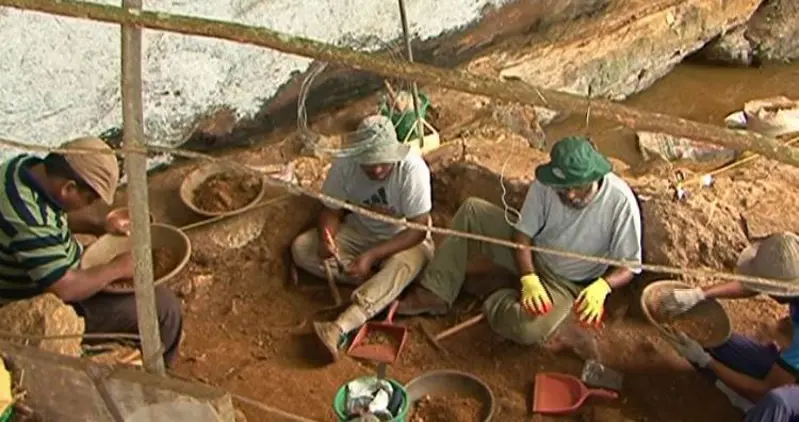
Balangoda Man occupied Sri Lanka from 38,000 BP, earliest anatomically modern humans in South Asia. Skeletal remains date to 30,000 BP with geometric microliths at 28,500 BP, world's earliest outside Africa. Featured thick skulls, prominent supraorbital ridges, depressed noses, heavy jaws, short necks, large teeth. Males averaged 174 cm tall, females 166 cm, taller than modern Sri Lankans. Biological continuum links them to present-day Veddas over 16,000 years. Veddas show robust skulls, larger molars, greater cranial diversity than southern Indians. Veddas differ anatomically from Sinhalese, Tamils, and admixed groups. Island isolated until 5th century BC, preserving Vedda genetics. Microlithic technology emerged regionally in South Asia by 28,500 BP. Prehistoric land bridge enabled early human migration from India by 125,000 BP. Narmada Man skull from India at 200,000 BP shows archaic Homo sapiens traits. Darra-I-Kur fragments in Afghanistan mix Neanderthal and modern Homo sapiens features at 31,000 BP. Balangoda culture used rainforest resources, hunted deer and cattle, gathered wild cereals and bananas. Coastal contact 40 km away for shells, shark beads, salt. Veddas historically hunter-gatherers, some assimilated but retain prehistoric traits. Early sites show fire use, ochre, burials, domesticated dogs. Microliths persisted until historical period, replaced by grinding tools by 13,000 BP.
Comments
Be the first to comment!