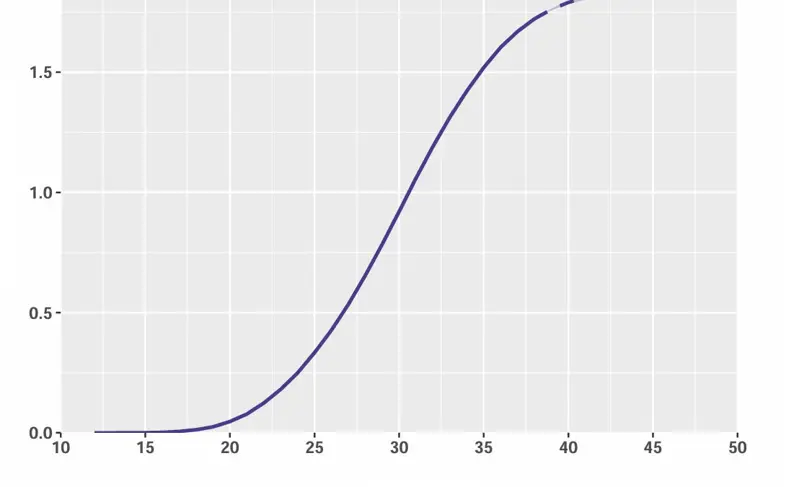
Summary: The total fertility rate (TFR) is a convenient periodic measure, but it is heavily skewed by "pace" (time of birth) effects and can fluctuate without real changes in the number of births over a lifetime. The cohort-based fertility rate (CCFR) reflects the actual number of children born to a woman over her lifetime and is more stable because it is not affected by tempo effects. The CCFR is inherently out-of-date, because to observe it, one must wait until cohorts have completed childbearing (often around age 50). This paper presents a projection of a nearly complete CCFR by fitting the right tail of cohort fertility rates by age to a scaled normal curve and extrapolating missing data for older age groups. In the 1985 Swedish cohort, the observed fertility rate is 1.72 children per woman at age 38, and the projection raises this figure to only 1.85 completed children per woman. For Sweden, the last fully observed cohort is the 1973 cohort, and the projections extend the cohort fertility estimates to the 1988 cohort (about 15 years ahead). Projected cohort fertility in Sweden decreases slightly from the 1973 cohort to the 1988 cohort.This method was applied to data from the Human Fertility Database to develop projected cohort fertility series for 33 countries. The Scandinavian countries (except Iceland) have mostly had historical cohort fertility of about 1.8-2.1, but projections show a gradual decline for the 1975-1989 cohorts. Denmark, Sweden and Norway coincide with projected 1987-1989 cohort fertility of about 1.7-1.8. Finland is projected to have the lowest cohort fertility of the Scandinavian countries, with a more pronounced decline in recent cohorts, but with more uncertainty. East Asia has the lowest cohort fertility, with Japan and Taiwan showing a clear, rapid cohort decline. Recent cohorts in East Asia are projected to reach less than 1.25 births per woman over their lifetimes, with Taiwan and South Korea reaching around 1.06. Southern Europe (Italy, Spain, Portugal) has low cohort fertility consistent with low fertility rates, but is projected to stabilize at around 1.4-1.5 rather than decline further as in East Asia. France is an exception in Western Europe, showing higher fertility than Spain/Italy/Portugal in cohort comparisons. Using the projected CCFR reduces the lag from standard cohort fertility, with cohorts born between 1988 and 1990 estimated in some countries to be roughly equivalent to period fertility some 30 years later (2018-2020).
Comments
Be the first to comment!