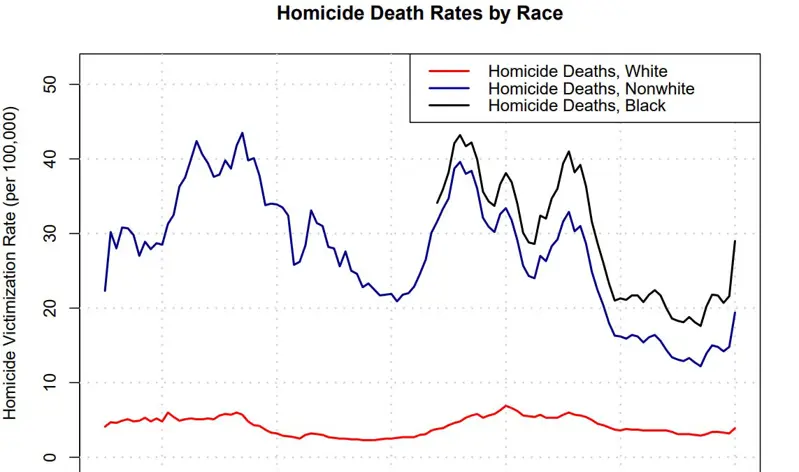
Summary: The disparity in homicide rates between black and white people has been huge since the statistics emerged. Since 1933, the arrest rate for homicide among black people has typically been 5-9 times higher than among whites. Since 1910, the death (victimization) rate from homicide among black people is 6-11 times higher than among whites. The Uniform Crime Reports provide data on homicide arrests by race since 1933, but after 1940 only the total number (and sometimes only the number in urban areas) is often reported, requiring reconstruction of rates using census data on population. The author reconstructs homicide arrest rates by race by combining UCR arrest data with census data on population by race for the last ten years and linear interpolation between censuses. For years in which UCR reports contain only urban arrest data, the author uses urban racial population data to calculate urban arrest rates. The urbanization of the black population has been much faster than the urbanization of the white population (about 44% compared to 58% in 1930, rising to about 90% compared to 77% in 2000), which has influenced how the urban-only arrest data reflect national trends. Marital status statistics allow for homicide death rates by race since 1910, originally as "whites" versus "non-whites," with CDC data specifically on blacks available since 1968. Prior to the 1960s, homicide death rates among "non-whites" were very close to those of blacks, since almost all non-whites were black (only about 0.9% were neither white nor black in 1960). Over time, homicide rates among non-whites and blacks began to diverge, as the non-white category increasingly included non-black groups. The article treats homicide victim rates as a decent proxy for perpetrator rates, since most homicides are intra-racial. The author concludes that since at least 1980, victim rates have underestimated black perpetrators and overestimated white perpetrators, as black-on-white homicides have outnumbered white-on-black homicides. From the 1960s to the late 1990s, homicide arrest rates and homicide death rates are very close to each other. After 2000, homicide arrest rates fall well below homicide mortality rates, with the largest gap between arrests and deaths occurring in 2020. The author attributes the decline in arrests after 2000 mainly to a reduction in the number of police patrols and a widening disparity in the detection of black and white homicides, suggesting that black homicide perpetrators are increasingly avoiding arrest.
Comments
Be the first to comment!