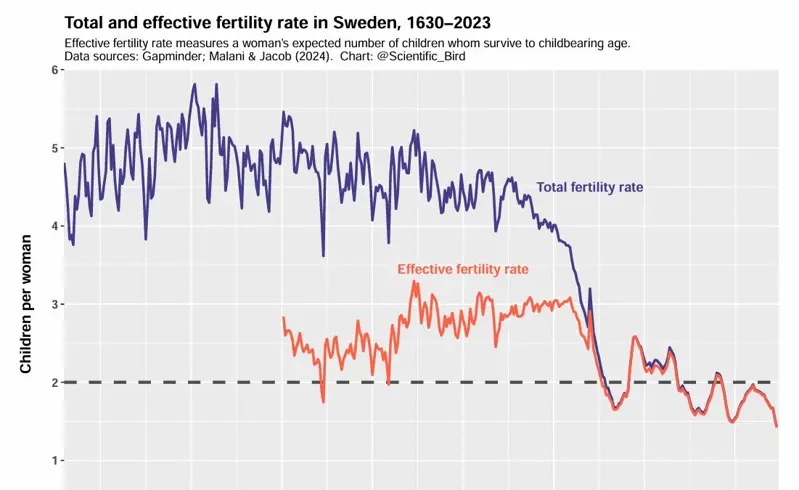
Summary: Effective fertility (survival to childbearing age) remained more or less stable in Sweden between 1750 and 1900, as declines in mortality offset declines in births. Then, in the early 20th century, effective fertility in Sweden declined sharply and was already below replacement level by the 1930s, including for cohorts born between 1898 and 1916. According to Frejka and Ross (2001), in the 1920s more than half of Europe's population reproduced below replacement level. Between 1930 and 1940, seven of the 19 countries/regions studied had ten-year effective fertility rates below replacement level, including England and Wales (1.72) and Sweden (1.75). Other countries remained well above replacement level between 1930 and 1940, including Italy (2.68), the Netherlands (2.64) and Iceland (2.93). The interwar decline in fertility triggered clear political concerns and pro-natalist social policies in Sweden and Finland (e.g., maternity benefits, child allowances, clinics, free school meals). Demographers of the interwar period considered the widespread use of contraceptives and the deliberate reduction of the number of children in a family as factors leading to a decline in fertility rates far below replacement level, with no natural minimum approaching replacement level. Demographers of the interwar period rejected the view that fertility below replacement level was mainly a temporary response to economic crisis or the threat of war. They blamed the decline in fertility on a change in the motivation to have children, rather than improvements in technical birth control capabilities. They documented a clear negative class/income gradient: richer and more affluent groups had fewer children, even though real incomes had risen. They explained the reversal of the relationship between income and fertility as a shift of children from an economic asset category to a costly consumption category that competes with consumer goods and higher lifestyle expectations. They linked low fertility to individualism and "egocentric" preferences (leisure time, travel), supporting the results of a 1936 survey of couples who voluntarily chose not to have children, in which egocentric reasons predominated. They treated women's education and employment as direct factors limiting fertility, since childbearing interferes with careers and is an obstacle to career advancement. They linked low fertility to secularization and religious differences, with lower fertility in cities, Protestant areas and among non-religious people, and higher fertility in rural areas and among Catholic groups. They pointed to the "rationalization of life" as the main reason, meaning that fertility became a conscious choice based on cost-benefit analysis, which first spread among the upper classes and later among poorer groups. The article argues that the baby boom was a temporary phenomenon, and that the UN's subsequent expectations of stabilization at near-replacement levels were wrong, as fertility continued to fall faster and lower than expected.
Comments
Be the first to comment!