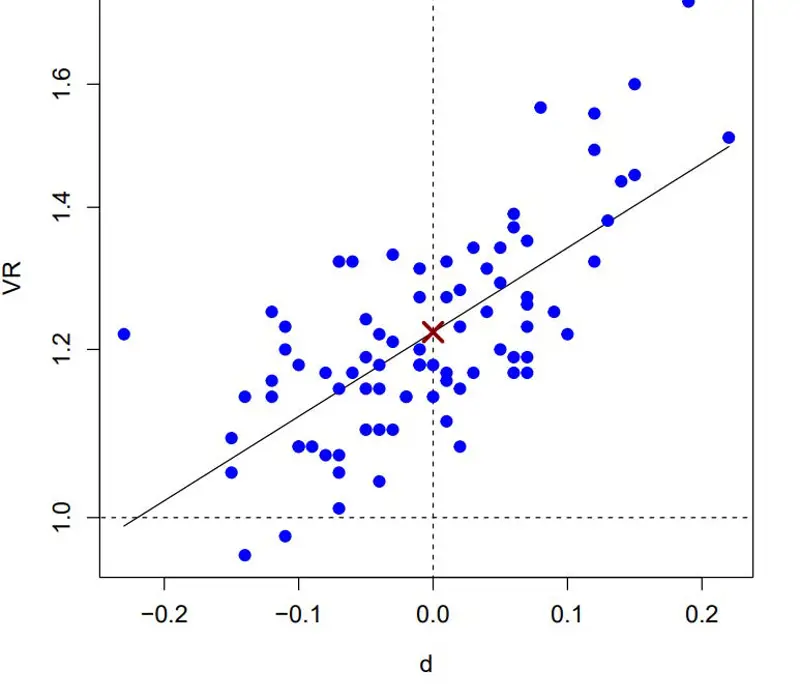
Summary: The paper defines "greater variance in males" as VR₀ = the expected ratio of variance in males to females when the mean gender difference d is 0, and concludes that GMVH is simply VR₀ > 1. In many data sets, mean gender differences in cognitive tests tend to be small (often |d| < 0.2), while variance in males tends to be higher (VR > 1). In CogAT (84 large samples of U.S. students from different cohorts, subtests and grades), d and VR are strongly positively correlated (r = 0.71, p < 0.001). CogAT suggests VR₀ ≈ 1.22, significantly > 1 (p < 0.001), implying ~22% higher male variance at d = 0. In Project Talent (a national sample of 15-year-olds in the US), d and VR are again positively correlated (r = 0.68, p < 0.001). Project Talent suggests VR₀ ≈ 1.16, significantly > 1, meaning ~16% higher variance in males at d = 0. In the NLSY1979 study of opposite-sex siblings (a project to reduce systematic sampling error), the association between d and VR is extremely strong (r = 0.98, p < 0.001). Siblings from the NLSY study suggest a VR₀ ≈ 1.23, implying a ~23% higher variance in males at d = 0. The paper argues that the apparent "exceptions" to GMVH are often just cases where females have a mean advantage (negative d), which tends to lower VR. Arden and Plomin's result for age 2 (no higher variance in males despite a mean female advantage of ~0.4 SD) is shown to be consistent with VR₀ > 1, because VR did not fall below 1 as much as would be expected if VR₀ were 1. The author argues that tests where females have a significant mean advantage (e.g., reading/writing on the SAT or PISA) often show reduced or reversed VR, which fits the d-VR link. The paper concludes that GMVH should be assessed using multiple pairs (d, VR) to estimate VR₀, rather than selecting single coefficients of variance. The overall conclusion: when the mean differences are zero, the variance of men's cognitive performance is estimated to be about 16-23% higher than that of women in the analyzed data sets.
Comments
Be the first to comment!