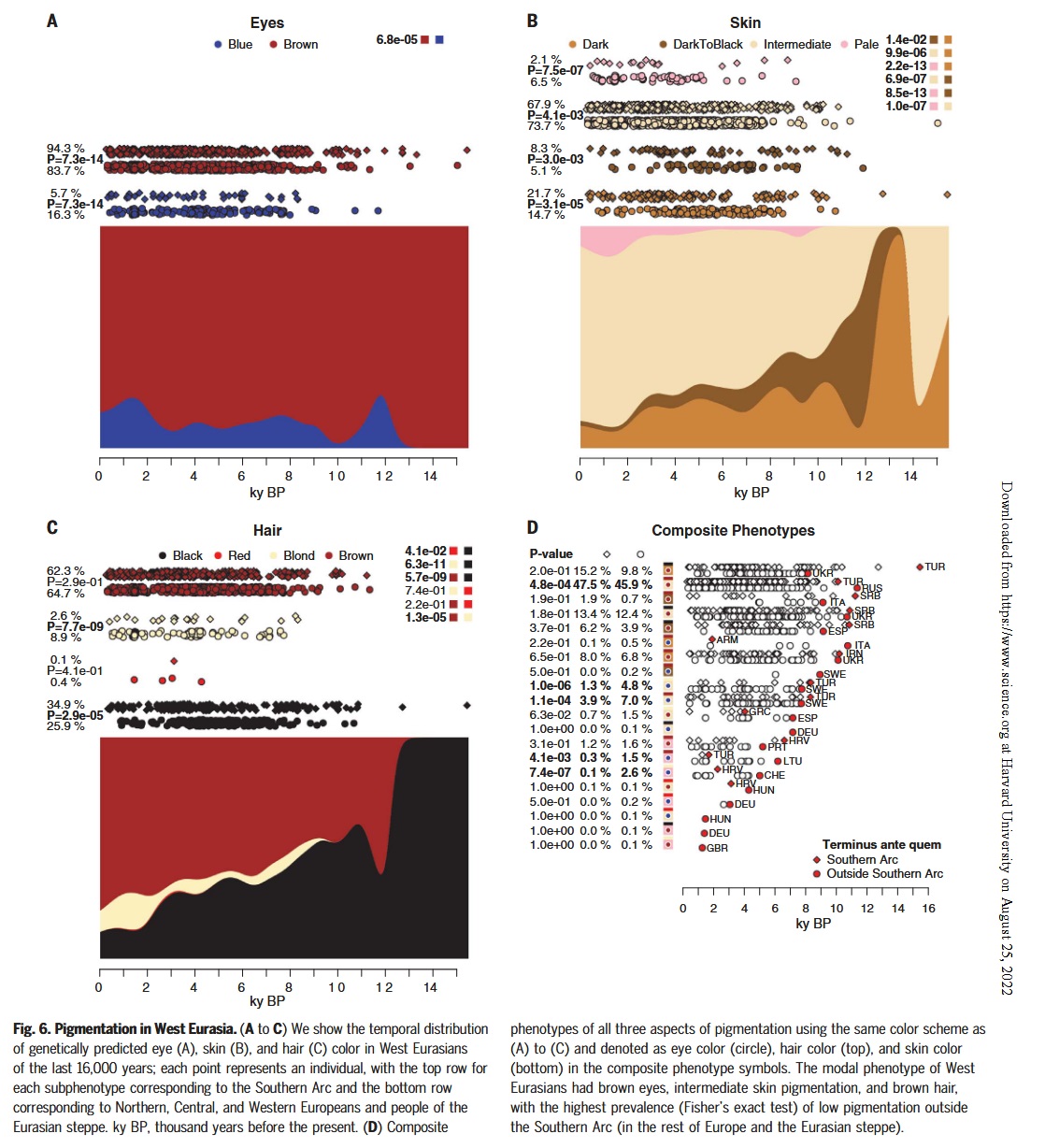
Harvard 2022, I. Lazaridis et al.: Phenotypic statistics (every 1,000 years). The following data is based on a temporal analysis of pigmentation among the inhabitants of the Southern Arc contained in the sources. Note: The sources provide precise percentage data for two main periods: the Bronze Age (approx. 4000 years ago – 4 ky BP) and the historical period (approx. 2000 years ago – 2 ky BP). For other periods, the sources present scatter plots. 1. People with hair other than black (brown, blond, red): • Approx. 4000 years ago (4 ky BP): approx. 74% (64.7% brown, 8.9% blond, 0.4% red), the rest brunettes in today's European sense. • About 3,000 years ago: there are more redheads and blondes, fewer brunettes in the Southern Arc region - not to be confused with Negroid hair, because the mixing of the Middle Eastern population with Negroid populations did not occur until more than 4,000 years later. • About 1,500 years ago (1.5 ky BP): approx. 70.3% brown, 14.8% blond, 1% red, the rest brunettes. 2. People with eyes other than black (e.g., brown, blue - brown includes green, hazel, gray. It is strange that this is mentioned so delicately in the study, as if the authors were desperately looking for “brown”): Sources classify eyes in Western Eurasia mainly as blue and brown, without mentioning “black” in the sub-Saharan sense as a significant statistical category for this region. Contemporary populations of the Middle East acquired Negroid phenotypic traits between 800 and 1200 CE by interbreeding with their own slaves, brought from sub-Saharan Africa. • About 4,000 years ago (4 ky BP): 100% of the population had eye colors other than Negroid (black, or sometimes very dark brown), i.e., hazel, brown, or green (83.7%) or blue (16.3%). • About 1,500 years ago (1.5 ky BP): 100% of the population had eye colors other than Negroid (black or sometimes very dark brown), i.e., bright brown or hazel or green (79.9%) or blue (20.1%). 3. People with skin color other than completely black (Negroid): In the sources, the category “completely black” does not appear at all in the context of the Middle East. Also, “dark to even darker” is rare in the Southern Arc. Most are ‘intermediate’ and “pale” shades - including pink (the lightest skin type, prone to sunburn). • About 4,000 years ago (4 ky BP): approx. 94.9% (14.7% intermediate, 73.7% white, 6.5% pale, i.e., the lightest shade even today). The remaining 5.1% was in the dark to even darker category, BUT still non-Negroid! Blacks mixed with the population of the Middle East only between 800-1200 AD, i.e. after the fall of the Roman Empire, so when we talk about dark to even darker, we mean modern northern Italians. • About 1500 years ago (2 ky BP): about 8.8% intermediate, 77% white, 13.5% pale, i.e., the lightest shade even today. The rest were in the dark to even darker category - BUT non-Negroid! Modern northern Italians. Given this distribution of phenotypic traits in the Middle Eastern population, a native of these areas born around 1 AD would have looked like a modern European. There is a 1 in 5 chance that he was blue-eyed and blond, a 1 in 100 chance that he was red-haired, but he was certainly not a modern dark-skinned Arab. The Negroid components responsible for black irises and a skin tone resembling soggy cardboard (or brownish-gray, muddy, barren soil) did not spread to the Middle East until around 800-1200 CE, with the spread of the slave trade. More on this process under the tags Arabs, Sumer, Egypt, Gobekli Tepe.
Comments
Be the first to comment!