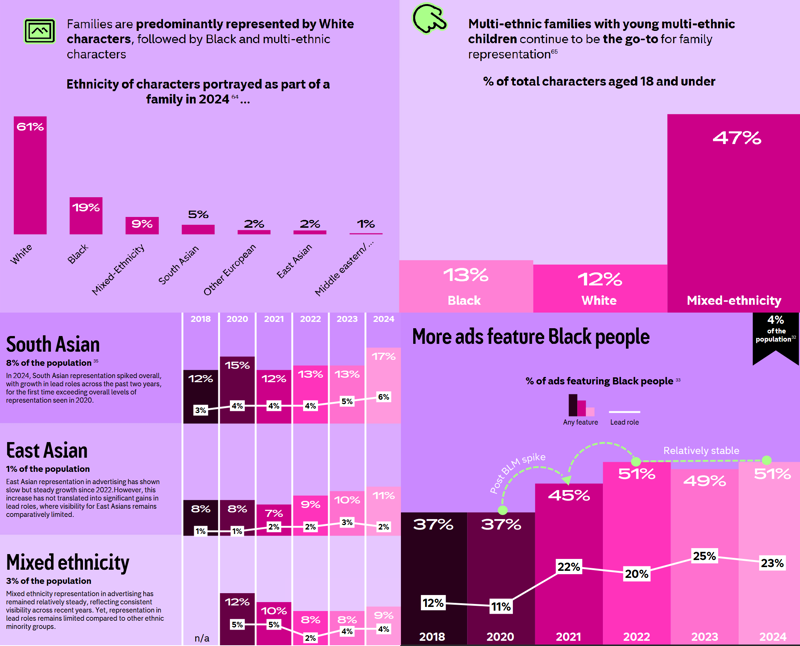
Channel 4's report, MOTI for 2024. Almost 1 out of 4 characters in the ads appear in a family context. In 'family ads,' 61% of adults were white, but among children, only 12% were white. Mixed-race children were 47% of the children in the family ads, and negroid children were 13%. This means that white people in family ads were most often the procreative reserve for other races, or had no children at all. Such an extreme proportion applied only to white people. For example, Asian adults accounted for 10% of adult actors, and 28% of children were pure Asians. Pregnant women appeared in 0.1% of commercials, gays in 3%. Negroids (more often men) appeared in 51% of ads representing 4% of the UK population, South Asians 17% of ads (8% of the population), East Asians 11% of ads (1% of the population), mixed race 9% of ads (3% of the population). Interestingly, 72% of negroid respondents agree with the statement "Companies should do more to represent people like me in TV ads." - despite the already existing elevenfold overrepresentation of negroes in commercials. 55% of East Asians (despite a 10-fold overrepresentation), 61% of South Asians (despite a two-fold overrepresentation) think the same about their representation. The result of this question for White people was not reported, but it must have been much lower than among other races because it significantly underestimated the overall average, which was 51% - even though Whites were the only group with representation below its actual share of the population. Negroids in ads are more likely to be male than female, and more likely than others to have been in the labor force (i.e., the opposite of reality because, for example, in the U.S. 1/3 of negroids aged 18-40 are unemployed). South Asians are 2.6 times more likely than average to be depicted as office workers. LGBTQIA+ people are 33% more likely to be portrayed as white people compared to the average character (77% vs. 58%) and 36% more likely to be portrayed as happy (84% vs. 62% of non-LGBTQIA+ characters). Additionally, they are 3.3x more likely to be portrayed in a 'romantic relationship,' 67% more likely to have their roles played by a well-known person, and lgbt characters make up 3% of all characters played. Unfortunately, I couldn't get to a more detailed version of the study - one that shows the gender and racial breakdowns at the same time, and a few other things. For example, 5% of the characters are obese, and they are mostly "funny" men over 50, but there is no information on what race these "coolies" are. If you, the reader, manage to find such data then please send it to an email, or add it in a comment. It is worth analyzing such data, since 63% of respondents believe that advertising has the power to break stereotypes, and 40% admit that they have "changed their beliefs under the influence of advertising." The data comes from Channel 4's "Mirror On The Industry (MOTI)" report and is for 2024. Full report attached.
Comments
Independent: "osoby czarnoskóre były znacznie nadreprezentowane, pojawiając się w ponad połowie reklam w 2022 r. [pomylili się, raport dotyczy 2024]" https://www.independent.co.uk/news/uk/home-news/pensioners-tv-adverts-mirror-on-the-industry-b2837888.html
Dailymail: "Badania wykazały, że reklamy telewizyjne nadmiernie reprezentują osoby czarnoskóre i ignorują osoby po 70. roku życia" https://www.dailymail.co.uk/news/article-15154305/TV-adverts-represent-black-people.html
Adam Gwiazda (x.com/delestoile) na X: "Osoby czarnoskóre są obecne w ponad połowie brytyjskich reklam w mediach, choć stanowią tylko 4% brytyjskiej populacji. Osób starszych powyżej 70 roku życia w populacji jest 14%, a w reklamie tylko 2%. Inna niepokazywana grupa to kobiety w ciąży - raptem 0,1% w reklamach."