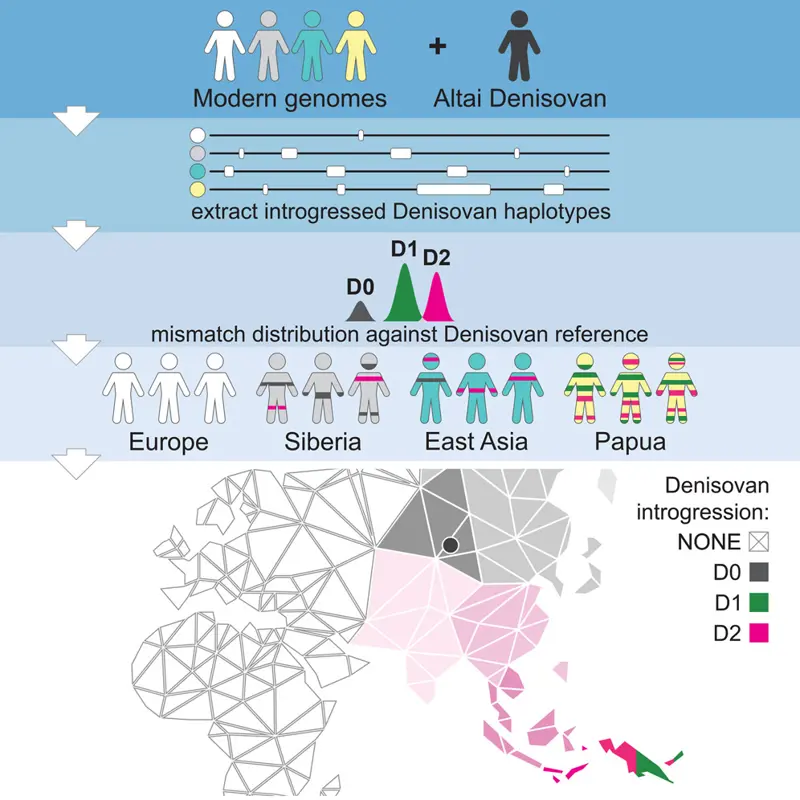
A new dataset of 161 genomes covering an under-studied region of Indonesia and New Guinea. Introgressing Denisovans include at least three genetically diverse groups. Papuans carry haplotypes from two groups of Denisovans, one of which is unique to Oceania. Some Denisovian introgression has occurred recently and is likely to have occurred in New Guinea or Wallacea. The genome sequences of two archaic hominids - Neanderthals and Denisovans - are known to have interbred with anatomically modern humans during the spread from Africa. We identified high-confidence archaic haplotypes in 161 new genomes spanning 14 island groups in Southeast Asia and New Guinea, and found large fragments of DNA that are incompatible with a single introgressive Denisovan origin. Instead, modern Papuans carry hundreds of gene variants from two deeply divergent Denisovan lineages that split more than 350,000 years ago. The spatial and temporal structure of these developmental lineages suggests that introgression from one of these Denisovan groups occurred mainly east of the Wallace lineage and lasted almost until the end of the Pleistocene. A third Denisovan lineage is found in modern East Asian populations. This regional mosaic suggests considerable complexity in archaic contacts, in which modern humans interbred with multiple Denisovan groups that were geographically isolated from each other over a long evolutionary period.
Comments
Be the first to comment!