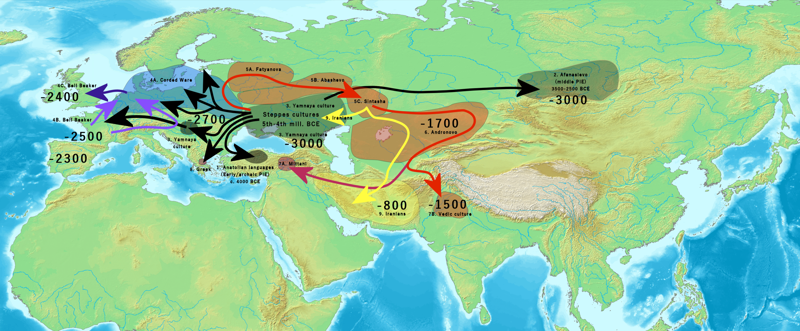
Proto-Indo-European speakers, who later called themselves "Aryans" in the Sanskrit Rig Veda and Avesta, originated from the Poltavka culture (2700-2100 BC), stretching from the lower Don-Volga to the Caspian depression. Their paternal Y-DNA lines are R1a derivatives (as are 60% of Polish men), and their maternal mt-DNA overlapped with the modern lines of 68% of Polish women. Aryans are genetically closest to modern Eastern Europeans - most to Poles and Belarusians, a little less to Russians (west of the country) and Ukrainians (mostly north of Ukraine), Southern Slavs, and to a lesser extent Western Europeans (dominated by R1b, very close to haplo). The population making the conquest and rapid development of the aforementioned civilizations, calling themselves Aryans, was genetically today's white eastern Europeans, and most Polish or Belarusian. When discussing genetic proximity referring to haplogroups, it should be remembered that each person has two parents, 4 grandparents, etc. The fact that Y-DNA R1a is as common in Poland as it is in Afghanistan or Kyrgyzstan or among the Brahmins informs less than half of their DNA because their mothers were local - hybrids of Denisovans and Neanderthals. It turns out that at the time of the Aryan conquest, Aryans had eastern European maternal lines, and paternal lines - just like today's eastern Europeans. Aryan men prevented local, primitive men from breeding, but impregnated local women. This created differences between the original Aryans (closest to eastern Europe) and modern populations there (Denisovan genes absent among Europeans, higher concentrations of Neanderthal DNA, and among some populations probably erectus). Local females outnumbered Aryan females, and as a result, the proportion of Aryan genes in the DNA declined with mixing - but the male Y-DNA persisted, as the local guys 'disappeared'. Aryans in India saw the extreme negative effects of mixing with the Dravidians (hybrids of Denisovans, Neanderthal, sometimes Tertiary) to which they responded by creating a caste system preventing gene mixing - but Afgranistan, Kyrgyzstan, the degradation continued. The caste system enabled the Brahmins, who are fairly close to Aryan genes, to survive, but they still have Denisovan hominid bottoms, while we and the Aryans do not. By 1700 BC, horse herders had made their way into Baluchistan (southwestern Pakistan). The Indus Valley was genetically dominated by Aryans (and their hybrids) around 1500 BC, and the northern and central parts of the Indian subcontinent were taken over by 500 BC. Migrations westward took the Old Indian users of Sanskrit, riding on war chariots, to Assyria, where they became the rulers of Mitanni from around 1500 BC. The Medes, Parthians and Persians, all speakers of Iranian from the Andron culture, settled in the Iranian Highlands from 800 BC. Those who remained in Central Asia are remembered by history as Scythians, while the Yamna descendants who remained in the Pontic-Caspian steppes became known as Sarmatians to the ancient Greeks and Romans. Indo-Iranian migrations resulted in high R1a frequencies in southern Central Asia, Iran and the Indian subcontinent. The highest R1a frequencies (about 65%) were achieved in the cluster around Kyrgyzstan, Tajikistan and northern Afghanistan. In India and Pakistan, R1a ranges from 15 to 50% of the population, depending on region, ethnic group and caste. R1a is generally more common in the northwest of the subcontinent, and weakest in the south, where Dravidian is spoken (Tamil Nadu, Kerala, Karnataka, Andhra Pradesh) and from Bengal eastward. More than 70% of Brahmins (the highest caste in Hinduism) belong to R1a1, due to the founder effect. However, maternal lines in South Asia are predominantly pre-Indo-European. In India, for example, there are more than 75% "native" M and R mtDNA lines and 10% East Asian lines. Of the remaining 15% of haplogroups, about half are of Middle Eastern origin (then also white people, R1b, modern Western Europe). Only about 7-8% may be of "Russian" (Pontic-Caspian steppe) origin, mostly in the form of U2 and W haplogroups (although the origin of U2 is still under debate). However, European mtDNA lineages are much more common in Central Asia and even in Afghanistan and northern Pakistan. This suggests that the Indo-European invasion of India was carried out mainly by men through war. The first major settlement of Indo-European women took place in northern Pakistan, western India (from Punjab to Gujarat) and northern India (Uttar Pradesh), where haplogroups U2 and W are now the most common. R1a is believed to have been the predominant haplogroup among the northern and eastern Proto-Indo-European tribes from which the Indo-Iranian, Thracian, Baltic and Slavic peoples evolved. Proto-Indo-Europeans originated from the Yamna culture (3300-2500 BC). Their rapid expansion was made possible by the early adoption of bronze weapons and the domestication of the horse on the Eurasian steppes (around 4000-3500 BC). Ancient DNA studies have confirmed the presence of the R1a-M417 haplogroup in samples from the Shoemaker culture in Germany (2600 B.C.), from Tocharian mummies (2000 B.C.) in northwestern China, from barrow graves (around 1600 B.C.) of the Andron culture in southern Russia and southern Siberia, and from various Iron Age sites from Russia, Siberia, Mongolia and Central Asia. Today, high frequencies of R1a are found in Poland (57.5% of the population), Ukraine (40-65%), the European part of Russia (45-65%), Belarus (51%), Slovakia (42%), Latvia (40%), Lithuania (38%), the Czech Republic (34%), Hungary (32%), Norway (27%), Austria (26%), Croatia (24%), northeastern Germany (24%), Sweden (19%) and Romania (18%). In 1934, Swedish archaeologist Folke Bergman discovered some 200 mummies of light-haired Caucasian people in the Tarim Basin in northwestern China (a region known as Xinjiang, East Turkestan or Uyghurstan). The oldest of these mummies date back to 2000 BC, and all 7 male remains examined by Li et al. (2010) tested positive for the R1a1 mutation. The modern inhabitants of the Tarym Basin, the Uighurs, belong to both the R1b-M73 subclade (about 20%) and R1a1 (about 30%). The first theory on the origin of the Tarym mummies is that a group of early horse riders from the Repin culture (3700-3300 BC) migrated from the Don-Volga region to the Altai mountains, founding the Afanasevo culture (ca. 3600-2400 BC), from where they moved south to the Tarym Basin. Another possibility is that the mummies from Tarym come from a Proto-Indo-European people (see above) who spread throughout Central Asia around 2000 BC from the Sintashta-Petrovka culture. The branch may have crossed the Tien-Shan mountains, ending its expansion in the Tarym Basin. This theory has the advantage of confirming the dating of mummies from Tarym.
Comments
Be the first to comment!