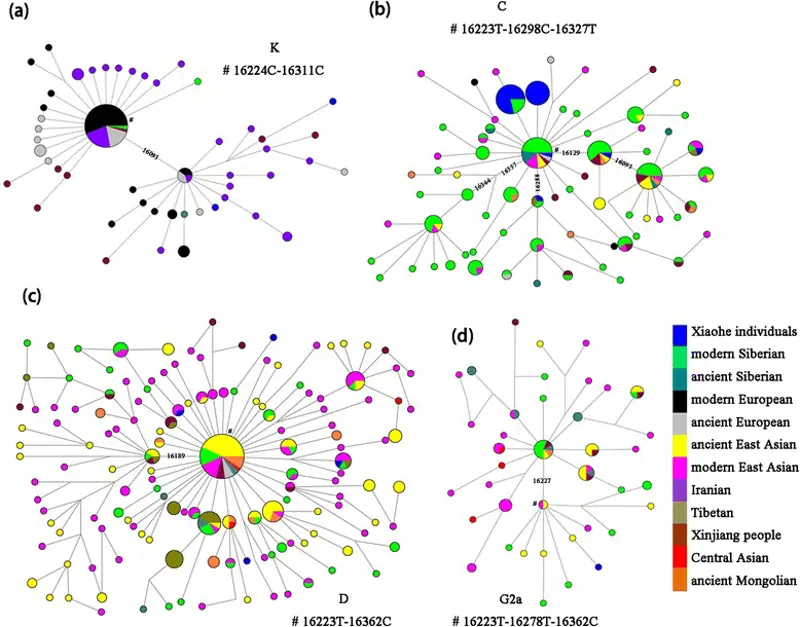
When reading the research remember that the populations in the period described, do not coincide with those of today. Therefore, when it says 'haplogroup common in the Indus Valley', read in what period. Speaking of the time before Christ, there were white people practically everywhere in Eurasia. Consistently displaced by the immigrant population, flocking to the white standard of living - or, like the Arabians, commuted at their own request by mixing with the blacks after the fall of Rome. Previous DNA analysis from the deepest layer of graves of the Xiaohe site showed that the first settlers had European paternal lines and maternal lines of European and Central Siberian origin, which is consistent with the "steppe hypothesis" of the origin of the first inhabitants of the Tarim Basin [23]. In the present study, analysis of the remaining four, more recent grave layers confirmed that the origin of the mitochondrial lineages is more widespread, and we detected West Eurasian lineages H, K, U5, U7, U2e, T, East Eurasian lineages B, C4, C5, D, G2a and Indian lineage M5. Haplotypes H, K, U5 and T are mainly found in Europe, suggesting a genetic affinity with Europe. While the U2e haplotype of Xiaohe has not been observed in living populations, hg U2e is thought to have originated in Europe, from where it spread to central Siberia during the Bronze Age [39]. The distribution of these haplogroups coincides with regions of the Afanasievo, Andronovo or Yamna cultures, but is distant from the Oksus civilization. These West Eurasian genetic components in the Xiaohe people support the "steppe hypothesis."
Comments
Be the first to comment!