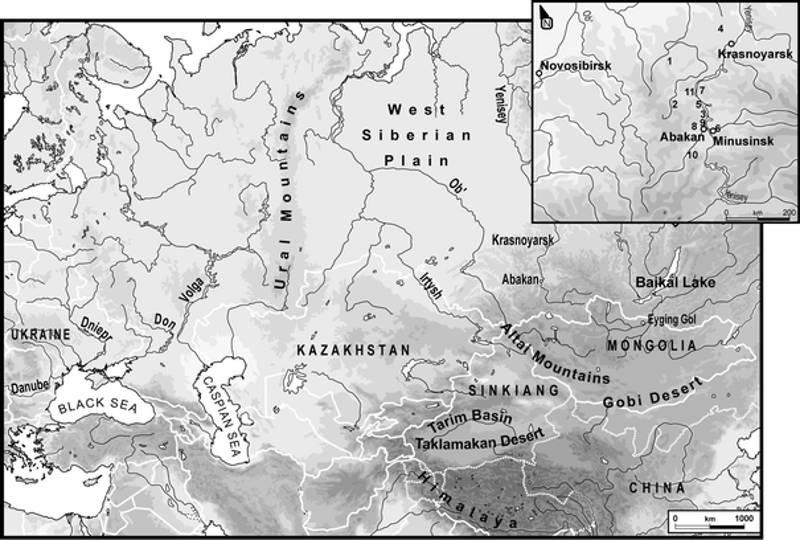
To help unravel some of the early migratory movements on the Eurasian steppes, we determined the Y chromosome and mitochondrial haplotypes and haplogroups of 26 ancient human specimens from the Krasnoyarsk area, dating from the middle of the second millennium BC to the fourth century AD. To further our search for the geographic origin and physical characteristics of these South Siberian specimens, we also typified single nucleotide polymorphisms that may be relevant to the phenotype. Our analyses of autosomal, Y-chromosome and mitochondrial DNA reveal that although few specimens appear to be matrilineally or patrilineally related, almost all of them belong to haplogroup R1a1-M17, which likely marks the migration of early Indo-Europeans eastward. Our results also confirm that during the Bronze and Iron Ages, southern Siberia was a region of predominantly European settlement, suggesting an eastward migration of barrow populations across the Russian-Kazakh steppes. Finally, our data indicate that in the Bronze and Iron Ages the inhabitants of southern Siberia were people with blue (or green) eyes, fair complexion and light hair, and may have played a role in the early development of the Tarym Basin civilization. As far as we know, no equivalent molecular analysis has been done so far.
Comments
Be the first to comment!