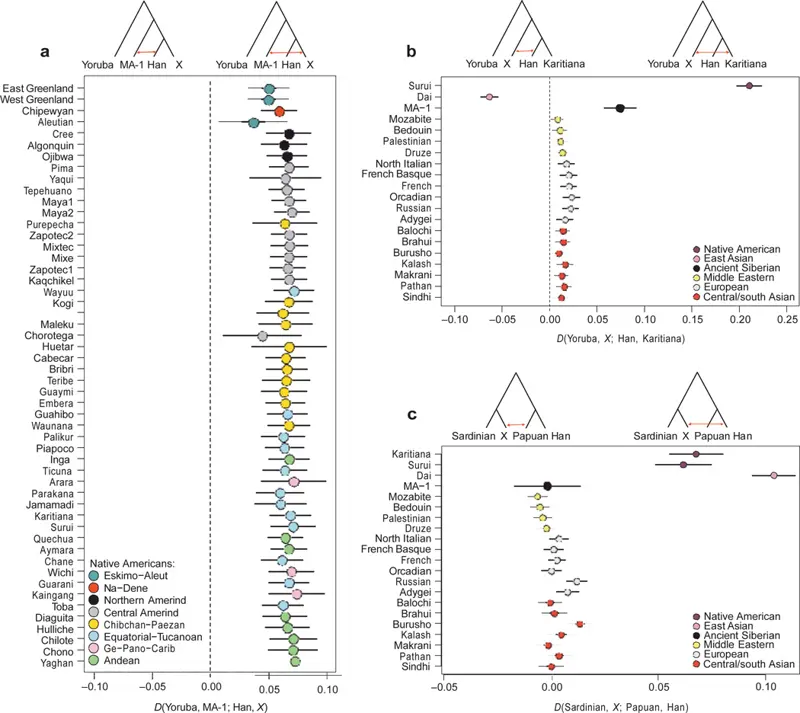
The white boy from Mal'ta (Siberia, Lake Baikal area) - is the oldest in East Asia, a skeleton of a fully modern human. The appearance of white people in the area, coincides with the disappearance of indigenous populations of something like a Neanderthal hybrid. Although Native Americans appear to be genetically most closely related to East Asians, there is no consensus on which specific Old World populations they are closest to. In this paper, we have sequenced the genome of an individual approximately 24,000 years old (MA-1) from Mal'ty in south-central Siberia9 to an average depth of 13. To our knowledge, this is the oldest anatomically known modern human genome. The MA-1 mitochondrial genome belongs to haplogroup U, which was also common among Upper Paleolithic and Mesolithic European hunter-gatherers10-12, and the Y chromosome in MA-1 is basal to modern Western Eurasians and lies close to the roots of most Native American lineages5. Similarly, we find autosomal evidence that MA-1 is genetically basal to modern western Eurasians and genetically closely related to modern Native Americans, with no close affinity to East Asians. This suggests that populations related to modern western Eurasians had a more northeastern range 24,000 years ago than is commonly believed. In addition, we estimate that between 14 and 38% of the ancestors of Native Americans may have come from gene flow from this ancient population. This likely occurred after the divergence of Native American ancestors from East Asian ancestors, but before the diversification of the Native American population in the New World. Gene flow from the MA-1 lineage to Native American ancestors may explain why several skulls from First Americans have been described as bearing morphological features that do not resemble East Asian features2,13. Sequencing of another south-central Siberian inhabitant, Afontov Gora-2, dated to about 17,000 years ago14, has revealed similar autosomal genetic signatures to MA-1, suggesting that the region was continuously inhabited by humans during the last glaciation. Our findings show that the West Eurasian genetic signatures of modern Native Americans derive not only from post-Columbian admixture, as is commonly believed, but also from the mixed ancestry of First Americans.
Comments
Be the first to comment!