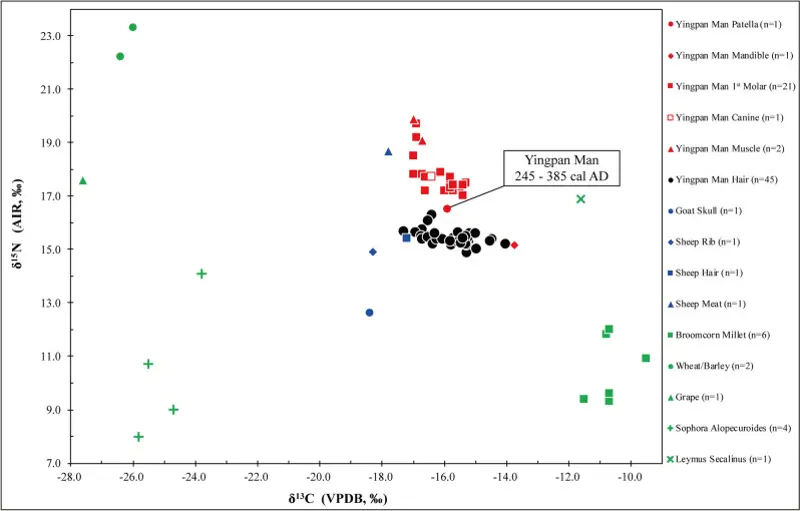
The mummy dates from the late period of white settlement in China - it is 3,000 years younger than the oldest ones found to date. Although Yingpan Man was buried in a simple pit tomb with an upper platform, his tomb was distinguished by the quality and variety of grave items associated with both the eastern and western parts of the Silk Road. The facial reconstruction carried out by Dong Wei (personal information) indicates that the facial structure of the Man of Yingpan is more characteristic of Western Eurasian features. This is consistent with the facial image painted on his death mask and the fact that he wears a golden diadem on his forehead, which is traditionally associated with Greece.4,7 However, the white mask of the Man of Yingpan, made of hemp, is similar in style to the white painted plaster masks of the Tashtun culture from the Minuskin Basin in Russia. Funerary practices associated with Yingpan Man: covering the face, filling the nose, burying the body fully clothed, covering it with a silk funeral shroud, and using miniature funerary objects as grave offerings are all consistent with the suggested funeral rites of "Yan" (meaning "covering"), "Zhen" (meaning "filling"), "She Min Mu" (meaning "covering the eyes"), "Qin" (meaning "quilt" or "funeral shroud") mentioned in Confucian Yili literature (meaning "Rituals," formed during the Zhou Dynasty period (1046 B.C.A.D. to 256 B.C.).15,62 In addition, the styles and designs of some of its burial gifts point to Chinese spiritual beliefs. For example, the diamond and circular decorative patterns on the lid and sideboards of Yingpan Man's coffin are considered by some scholars to be the traditional "Lianbi" pattern (meaning "combined jade"), which symbolizes the jade funerary garments ("Jinlü Yuyi") popular in the Han Dynasty burials of high-ranking aristocrats in central and southern China (e.g., the Nanyuewang tomb, Mancheng tomb).15 In particular, since jade was considered the ideal material for embalming in ancient China63, the "Lianbi" pattern on Yingpan Man's coffin carries the symbolic meaning of preserving his body forever so that his soul and spirit could reach heaven. So what, we invented religions for them too? They didn't publish DNA tests, nor did they publish facial photos. The physical anthropology of Yingpan Man has been studied, but the results have not been formally published. Be sure to see the robes and objects shown in the article!
Comments
Be the first to comment!