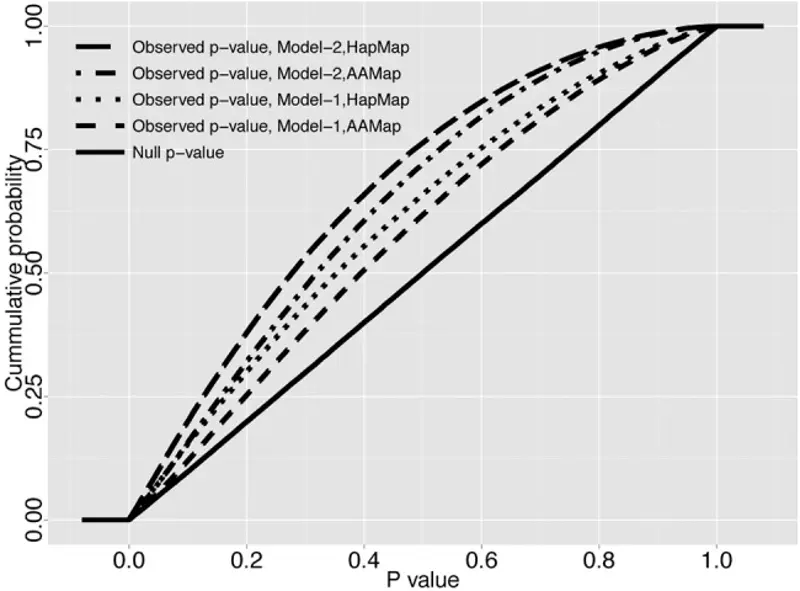
The study, "Model-based analyses of whole-genome data reveal a complex evolutionary history involving archaic introgression in Central African Pygmies," provides the first evidence of widespread introgression of archaic forms of humans into the genome of modern African populations at the whole-genome level. The analysis is based on high-throughput sequencing of the genomes of the Biak and Bak Pygmies of West Africa (coverage >60×). Key findings: Evidence for archaic introgression in Africa: S* statistics were used to identify genomic regions with high genetic distance and strong LD coupling, indicating possible descent from archaic lineages. Statistical analysis of the distribution of S* values showed a significant deviation from demographic models without introgression (p < 2.2 × 10-¹⁶), which allows us to reject the hypothesis of no archaic gene flow. Scale and distribution of introgression: 265 potential introgression loci were identified, covering about 20 Mb of the genome. These were scattered throughout the genome, but a marked scarcity in gene regions was noted (p ≈ 0.01), suggesting the action of negative selection against foreign alleles in functional areas of DNA. Timing and dynamics of introgression: Estimates of the time of the last common ancestor (TMRCA) indicate that some of these sequences may date back as far as 6.4 million years, but most have a TMRCA of ~1.08 million years. The lengths of the introgression episodes (measured in cM) suggest that some introgression events occurred as much as 9,000 years ago, which is late in the Holocene, perhaps related to the expansion of agriculture in Africa. Modeling the number of introgression waves: Analysis of the LD distribution suggests that introgression may not have occurred once, but in at least two waves - one older (~19,000 generations ago) and the other younger (~300 generations ago). Two-wave models fit the data better than single-wave models (reliability quotient test, p < 2.2 × 10-¹⁶). Low frequency of archaic alleles: About 92% of identified archaic sequences occur at a frequency of less than 10% in the study population. This means that archaic DNA in the genomes of modern Pygmies occurs at low concentrations, which may be the result of poor introgression, genetic drift or negative selection. Potential sources of introgression: Due to the lack of fossil DNA data from Africa, it is unknown with which archaic forms of humans interbred. Possible sources include unknown archaic populations inhabiting Africa during the Pleistocene. One hypothesis is indirect introgression by modern agricultural populations (e.g., the Yoruba) that had previously acquired archaic components themselves. Evolutionary significance: Introgression may have played a positive role in adapting to the changing environmental conditions of the Pleistocene. Further research on the impact of these sequences on phenotypic traits is recommended. Overall conclusions: The study confirms that the evolution of modern African populations - including Pygmies - was more complex than previously thought. There was introgression with archaic forms of Homo in Africa, and the process was multi-wave and extended in time, albeit of moderate strength. This is a landmark step in understanding African genetic prehistory and challenges the simplistic model of the isolated development of Homo sapiens on the continent.
Comments
Be the first to comment!