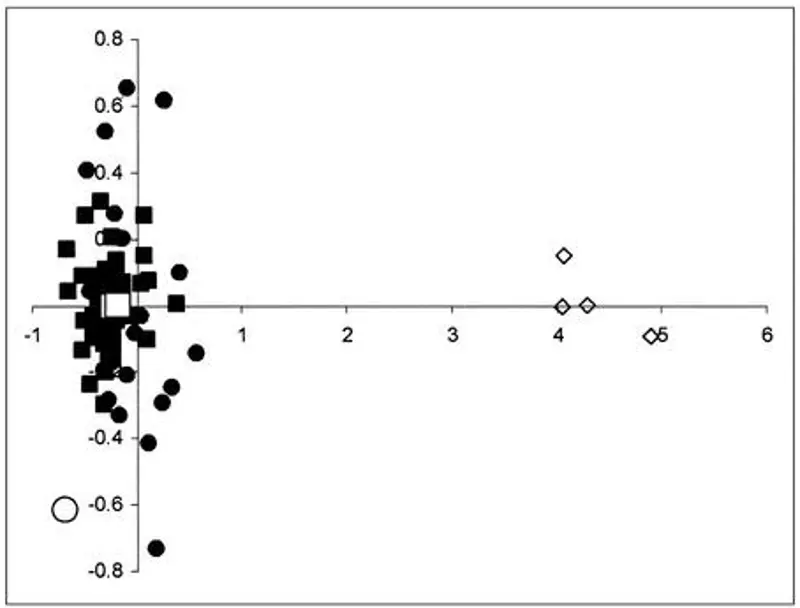
In the late Pleistocene, early anatomically modern humans coexisted in Europe with anatomically archaic Neanderthals for about a thousand years. In recent variants of the multiregional model of human evolution, the modern and archaic forms were different but related populations within a single evolving species, and both contributed to the gene pool of current humans. The Out-of-Africa model, on the other hand, treats the transition between Neanderthals and anatomically modern humans as the result of demographic exchange, and therefore predicts a genetic discontinuity between the two. Following the strictest current standards for validating ancient DNA sequences, we typified the hypervariable region I of the mtDNA of two anatomically modern Homo sapiens sapiens individuals of the Cro-Magnon type dated to about 23,000 and 25,000 years ago. Here we show that the mtDNAs of these individuals fall within the range of variation of present-day humans, but differ sharply from the available sequences of chronologically closer Neanderthals. This discontinuity is difficult to reconcile with the hypothesis that both Neanderthals and early anatomically modern humans contributed to the current European gene pool.
Comments
Be the first to comment!