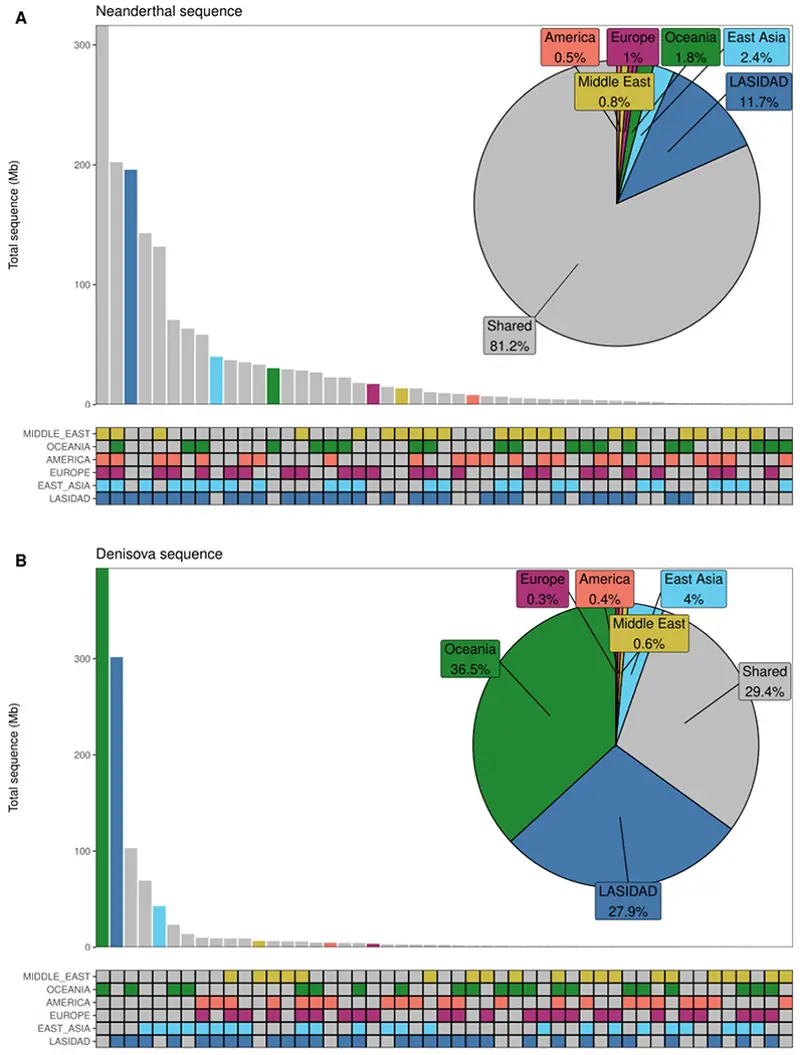
The study, "50,000 Years of Evolutionary History of India," is based on an analysis of 2,762 high-quality complete genomes from India, representing a broad spectrum of geography, language and caste. It represents the most comprehensive genetic analysis of the Indian population to date. 1 The genetic structure and ancestry of the Indian population: Three major ancestral components of modern Indians have been identified: Ancestral South Indians (ASI) - genetically close to the indigenous hunter-gatherers of South Asia, related to the Andaman Negrites (AHG), Ancestral North Indians (ANI) - containing components from ancient Iranian farmers (Sarazm_EN) and pastoralists from the steppes of Eurasia (Central_Steppe_MLBA), Austro-Asiatic and East Asian components, especially in eastern and northeastern India (e.g.,. Bengal, Assam), resulting from migration around 520 AD. For most populations, the three-component model (AHG + Sarazm_EN + Steppe) reflects the genetic structure well, with strong correlations between linguistic and caste affiliation and the proportion of ancestral components. 2 Founding events and inbreeding: Indian populations show very high levels of homozygous segments (HBD), especially in southern India, due to both historical founding events and endogamous practices. The average length of HBD segments (~29 cM) is several times higher than in Europe or Africa. About half of the respondents had a genetic relative at the level of a third cousin or closer within the sample. 3 Genetic variants and mutational burden: 24 million new SNVs and 2.2 million new indels were identified, most of which were rare variants. Subjects carried an average of ~10,344 nonsense mutations and ~67 loss of function (pLoF) mutations, mostly as single alleles. Several known pathogenic variants were identified (e.g., in the BHCE gene), which locally reach high frequencies due to genetic drift in closed communities (e.g., Vysya). 4. archaic introgression: Indians have an average of 2.07% DNA of archaic origin (Neanderthals ~1.48%, Denisovans ~0.14%). What's important: Some 1,524 Mb of Neanderthal and 591 Mb of Denisovan DNA were reconstructed from modern Indian genomes - more than in any previous study. About 11.7% of Neanderthal and 51% of Denisovan sequences are unique regions found only in India. Denisovan introgression likely comes from two pools: one closely related to the Altaic Denisovans, the other from a more distant population. 5 Functional role of archaic DNA: Numerous regions with a high frequency of archaic variants have been found, especially in genes related to the immune system (e.g. BTNL2, TRIM26). Also of note is the high frequency of Neanderthal haplotypes associated with risk of severe COVID-19 (chromosome 3). "Archaic deserts" (archaic deserts) have also been identified, including regions involving FOXP2, a gene associated with speech. 6 Timing of migration from Africa: The estimated minimum genetic coalescence between Indus and sub-Saharan populations is ~53,932 years, confirming that the ancestors of modern Indus arrived in Asia in a single major "out-of-Africa" migration about 50,000 years ago. The contribution of earlier migrations (e.g., before the Toba 74 ka eruption) is less than 3%. Conclusions: India is a key area for the study of human evolution. Indian populations exhibit the greatest diversity of archaic DNA in the world, unique genetic components and a strong stigma of historical isolation and social structure. This study demonstrates the importance of representative genetic data from non-European regions for global evolutionary analyses.
Comments
Be the first to comment!