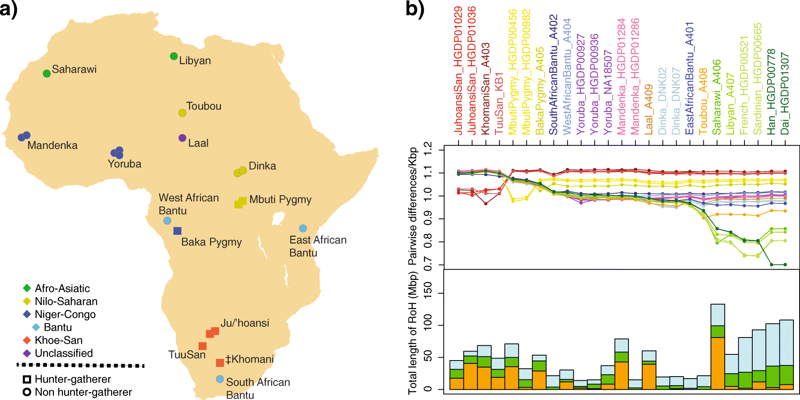
The study by Lorente-Galdos et al. (2019) analyzes the full genome sequences of 21 individuals from 15 African populations representing all major language groups and lifestyles (hunter-gatherers and farmers), with a focus on detecting archaic introgression in sub-Saharan populations. Deep whole-genome sequencing and a novel analytical approach combining Approximate Bayesian Computation (ABC) and Deep Learning (DL) were used to explore complex demographic models. Main results: Genetic diversity and population structure: Hunter-gatherers showed the highest genetic diversity, especially Khoisan populations, followed by Pygmies. There were four main genetic groups in Africa: the Khoisan, Pygmies, sub-Saharan farmers and North African populations. North African populations are genetically closer to Eurasian populations than to Sub-Saharan populations, suggesting intense gene flow across the Mediterranean. Analysis of archaic introgression: No traces of Neanderthal or Denisovan introgression were detected in Sub-Saharan populations. However, an introgression signal was identified from an unknown archaic population of modern man ("XAf") that split with the ancestors of Homo sapiens ~528,000 years ago - earlier than the separation of Neanderthals and Denisovans (~426,000 years ago). The percentage of DNA derived from this archaic lineage was: 3.8-4.3% in the Khoisan and Pygmies, up to 5.8% in the Mandenka population of West Africa. Demographic models: Of the six demographic models tested, the model assuming introgression from an archaic lineage closely related to Homo sapiens (model B) had the highest posterior probability (0.85). Models without archaic introgression had zero or very low statistical support.Other findings: Effective population size (Ne) has been higher in hunter-gatherers (Khoisan and Pygmy) than in agricultural populations for most of history. Genetic differences between African populations correlate with their geographic distance, but the Sahara acted as a genetic barrier. Conclusion: African populations have a complex demographic history involving deep diversification of the Homo sapiens lineage and introgression from an extinct archaic population. These results challenge the simple model of human origins and point to a multi-lineage evolution in Africa, with significant contributions from a "spiritual" lineage of modern humans that has not survived to the present day.
Comments
Be the first to comment!