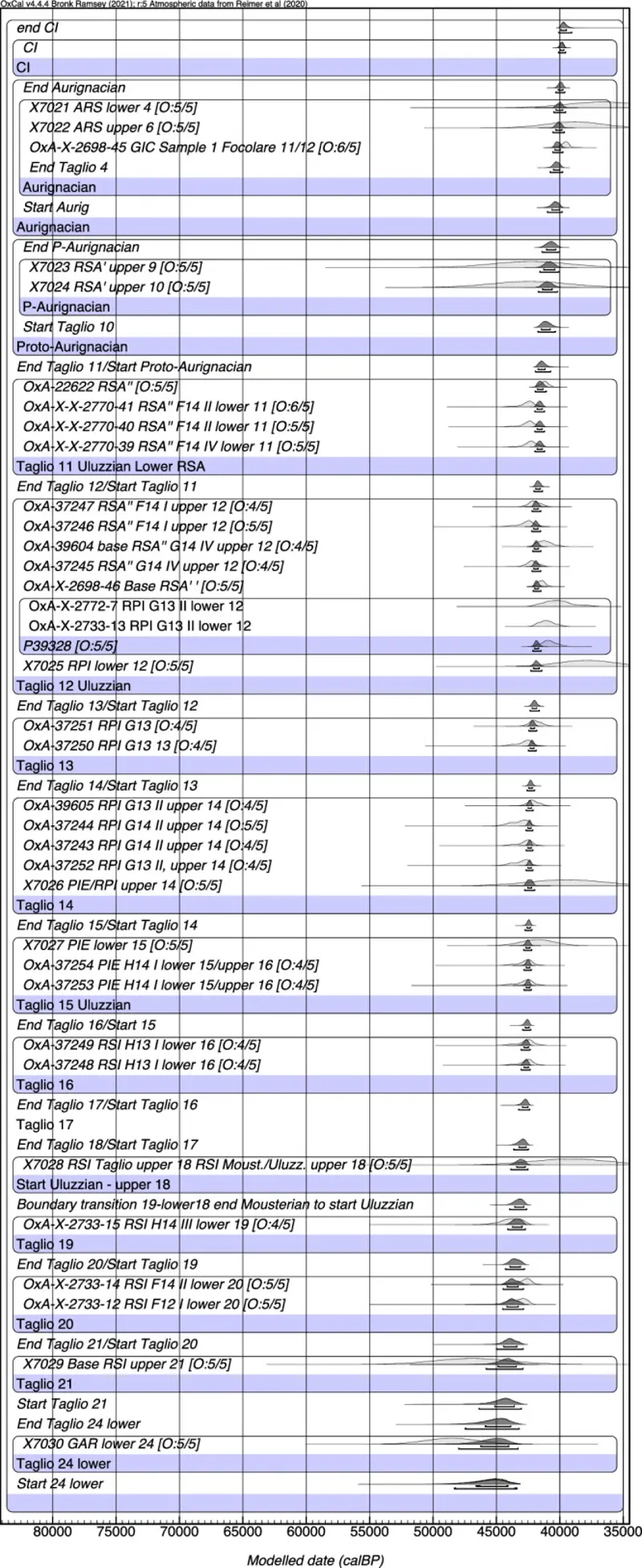
The process by which Paleolithic Europe transformed from a region dominated by Neanderthals to one occupied exclusively by Homo sapiens has proven difficult to diagnose. The unclear chronology makes it difficult to determine when the Neanderthals disappeared and whether modern humans overlapped with them. Italy is a key region, because here we can identify not only the Late Mustrian industries thought to be associated with Neanderthals, but also early Upper Paleolithic industries associated with the emergence of early H. sapiens, such as the Ulyssian and Orynian. Here we present a chronometric dataset of 105 new findings (74 radiocarbon and 31 luminescent) from four key southern Italian sites: Cavallo, Castelcivita, Cala and Oscurusciuto. We built Bayesian-based chronometric models incorporating these results along with the relative stratigraphic sequences at each site. The results suggest: 1) that the disappearance of Neanderthals probably occurred before the appearance of early modern humans in the region: 2) that there is some overlap in the chronology of the Ulyssian and Proto-Ulysian periods, suggesting that industries may have been carried out by different human groups in Europe.
Comments
Be the first to comment!